
If you’ve started looking into small business website design, you’ve probably noticed one thing pretty quickly: every company seems to offer different packages, different pricing, and slightly different promises. Honestly, it can get pretty confusing. It’s hard to compare your options when you don’t even know what’s included in each package or what your business actually needs.
Here’s something that’s worth keeping in mind before you go any further: a website isn’t really a “purchase” in the same way you buy a logo or business cards. It’s more like a piece of business infrastructure. It’s where potential customers go to see if you’re legitimate, learn what you offer, and decide whether they should contact you instead of going with a competitor. And, in many cases, it’s where they take the action that eventually turns into a lead or a sale.
That’s why treating your website as nothing more than an online brochure can backfire. You might end up spending money rebuilding the same website every year or two instead of having a site that grows along with your business.
At WP Badgers, we work with small business owners who want a website that actually works for their business – not just one that looks good sitting online. In this guide, we’ll break down what’s typically included in small business website design packages, what factors affect the price, and what you should prioritize based on where your business is right now.
And hey, if you’d rather skip all the reading and just talk through what you actually need, that’s totally fine too. You can book a free consultation with our team and we’ll help you figure out what makes the most sense for your business.
What Is Small Business Website Design?
Small business website design is basically the process of planning, designing, and building a website around a specific business, its brand, customers, services, and goals. In other words, it’s not just about picking a template, adding some text and images, and calling it a day.
For a small business, the website really needs to get a few important things right. It should clearly explain what you do, help visitors trust your business, make it easy for them to contact you or make a purchase, and work just as smoothly on a phone as it does on a desktop. Compared with a large enterprise website with tons of departments, pages, and people involved in every decision, a small business website is usually much more focused. And honestly, that can be a good thing – you can keep the site simple, fast, easy to navigate, and focused on guiding visitors toward one clear next step.
What Should a Small Business Website Package Include?
This is where a lot of confusion happens, because “website package” means different things at different companies. At a baseline, a solid small business website package should include:
- Professional design – either custom-built or a well-configured, professionally adapted theme that matches your brand
- Mobile-responsive layout – the site needs to work properly on phones and tablets, not just desktops
- Clear, user-friendly navigation – visitors should find what they need in a couple of clicks
- Contact forms – set up correctly, tested, and routed to the right inbox
- Basic on-page SEO – page titles, meta descriptions, header structure, and image alt text done properly from the start
- Speed and performance optimization – compressed images, clean code, and reasonable load times
- Basic security setup – SSL, secure login practices, and sensible hosting configuration
- Analytics and tracking – so you can actually see how the site is performing
- Conversion-focused calls to action – buttons and prompts that guide visitors toward calling, booking, or buying
- Organized content structure — pages that are laid out logically instead of dumped together
- Social media integration – where it makes sense for the business
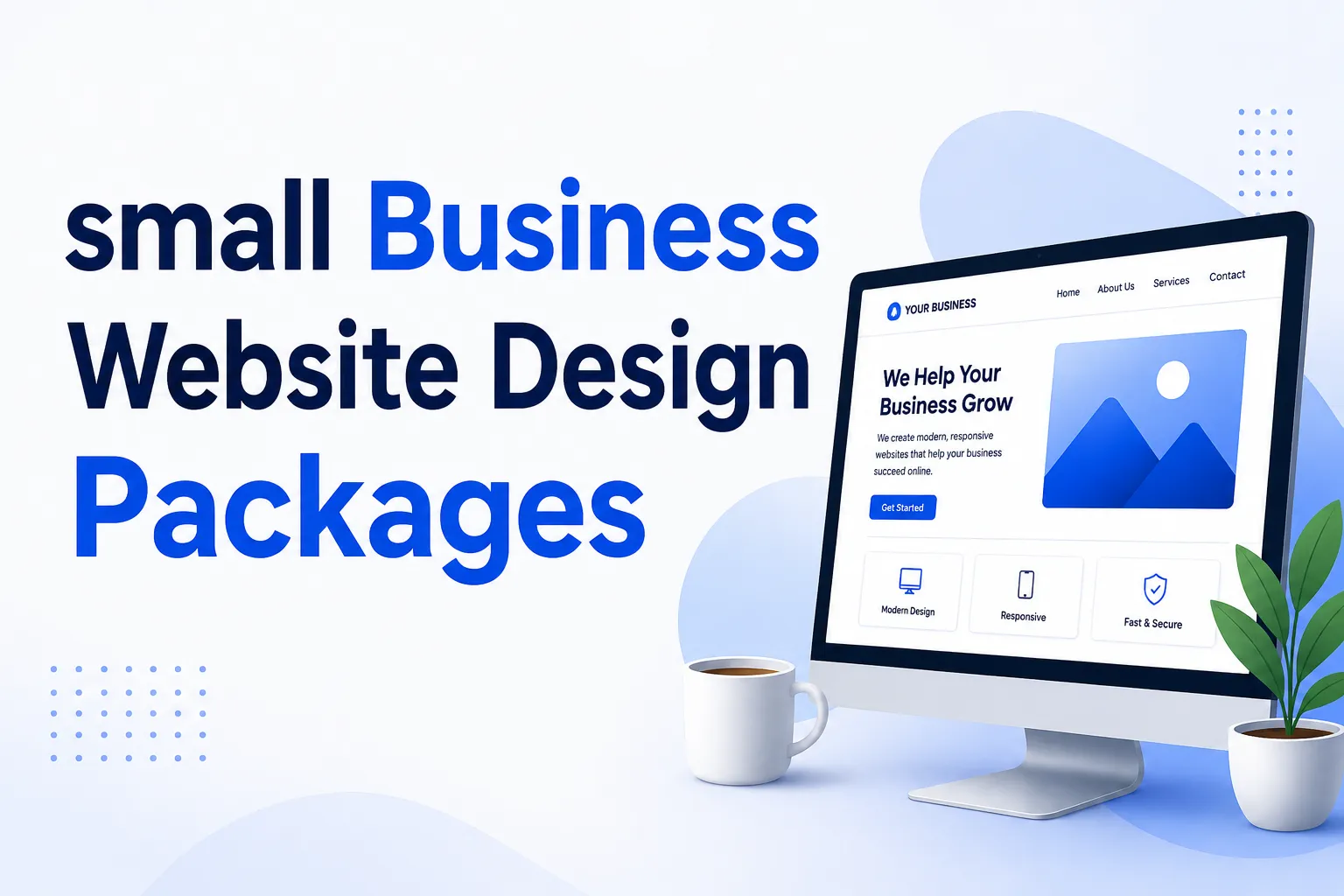
Small Business Website Design Packages
Most website design companies, including WP Badgers, structure their offerings into a few tiers so businesses at different stages can find a reasonable starting point. Here’s a general way to think about how these tend to break down.
Starter Website Package
Best for: Solo entrepreneurs, new businesses, and service providers who need a professional presence without a large scope.
Typical pages: Usually 3–5 pages – home, about, services, contact, and sometimes a simple gallery or testimonials page.
Key features: Clean responsive design, contact form, basic SEO setup, and a mobile-friendly layout.
Ideal for: Local service businesses, freelancers, and consultants who mainly need credibility and a way for people to reach them.
When to upgrade: If you start needing multiple service pages, blog content, booking systems, or you’re getting enough traffic that basic SEO isn’t cutting it anymore.
Professional Business Website Package
Best for: Established small businesses that need more structure, more content, and stronger SEO groundwork.
Typical pages: Often 6–12 pages, sometimes including a blog or resources section.
Key features: More refined custom design, deeper on-page SEO, structured content strategy, integrated analytics, and more advanced contact or lead-capture forms.
Ideal for: Businesses with multiple services or locations, or ones that rely on organic search and local visibility to bring in customers.
When to upgrade: When you need e-commerce functionality, gated content, membership areas, or more advanced marketing integrations.
Growth Website Package
Best for: Businesses ready to scale – more traffic, more content, more functionality, and often e-commerce or advanced lead generation.
Typical pages: Highly variable, often 12+ pages, with room to keep expanding.
Key features: Custom functionality, e-commerce or booking systems, advanced SEO architecture, CRM or marketing tool integrations, and a scalable content structure.
Ideal for: Growing companies, franchises, or startups that expect to add products, services, or locations over time.
When to upgrade: Honestly, at this tier it’s less about upgrading packages and more about ongoing optimization – SEO, conversion rate work, and adding functionality as the business evolves.
Exact inclusions in each of these tiers can shift depending on your industry, existing brand assets, and specific goals, so think of this as a starting framework rather than a fixed menu. If you want a clearer sense of where your project would land, that’s a good thing to walk through during a free consultation.
Affordable Website Packages: What Does “Affordable” Really Mean?
Everyone wants an affordable website. Fair enough. But “affordable” and “cheap” aren’t the same thing, and mixing them up is one of the most common mistakes small business owners make when comparing quotes.
A cheap website that’s slow, hard to update, poorly structured for search engines, or built on a platform you’ll outgrow in a year isn’t actually a good deal – it just moves the cost to later, usually in the form of a rebuild plus the lost traffic and leads you missed in the meantime.
Genuinely affordable website packages should still give you:
- A site that loads quickly and works properly on mobile
- A structure search engines can actually crawl and understand
- Room to add pages or features without a full rebuild
- Reasonable ease of updating content yourself, or clear support if you need help
- A design that doesn’t need replacing the moment your business grows a little
Before comparing prices, it helps to get clear on what you’re comparing. Ask what’s included, what happens after launch, and whether the platform can grow with you. A lower number on a quote doesn’t mean much if half of what you need isn’t actually in scope.
Website Design for Startups: What Should You Prioritize?
Startups are in a different position than an established small business. Budgets are tighter, timelines are usually shorter, and priorities can shift fast as the business finds its footing. That changes what website design for startups should actually focus on.
A few things matter more than others at this stage:
Speed to launch. You need a site live and working, not a six-month design process. A startup’s website should get the business functioning online without unnecessary delays.
A foundation that won’t need tearing down. It’s fine to start smaller, but the underlying structure – platform, hosting, content organization – should be able to grow with you instead of forcing a full rebuild in a year.
Clear branding, even if simple. You don’t need an elaborate visual identity on day one, but the site needs to look intentional and consistent, not thrown together.
A working lead generation path. Whether that’s a contact form, a booking tool, or an email signup, the site needs at least one clear way to capture interest from visitors.
Mobile responsiveness from the start. A large share of early traffic for most startups comes from mobile, especially if you’re promoting the business through social media.
Basic SEO foundations. Getting page structure, titles, and metadata right from day one is far easier than retrofitting it after the site has grown.
A visible next step. Every page should make it obvious what you want the visitor to do next – sign up, book a call, request a quote, whatever fits your business model.
The goal for a startup site isn’t to build something perfect and permanent. It’s to build something functional, credible, and flexible enough to evolve as the business does.
How Much Does Small Business Website Design Cost?
There’s no single number that applies across the board, because cost depends entirely on scope. What drives the price up or down usually comes down to a handful of factors:
- Number of pages – more pages generally means more design and content work
- Custom design vs. template-based design – fully custom work takes more time than adapting an existing framework
- Functionality – booking systems, membership areas, or custom forms add development time
- E-commerce requirements – product catalogs, payment integration, and inventory setup add real complexity
- Copywriting – whether you’re providing content or need it written for you
- SEO work – basic on-page SEO versus a deeper SEO strategy
- Third-party integrations – CRM tools, email marketing platforms, scheduling software, and similar connections
- Ongoing maintenance and hosting – many packages separate one-time build costs from recurring support
When you’re evaluating quotes from different companies, it helps to ask each one to break down exactly what’s included in these categories, rather than just comparing bottom-line numbers. Two quotes that look similar on price can represent very different amounts of actual work.
How to Choose the Right Website Design Package
Before committing to a package or a provider, it’s worth working through a short checklist:
- Define your business goals. Are you generating leads, selling products, building credibility, or all three?
- Identify the pages you actually need. Don’t pad the site with pages that won’t get used.
- Determine required functionality. Booking, e-commerce, membership access, and similar features change the scope significantly.
- Think about growth. Will this site still make sense in two years, or are you likely to outgrow it fast?
- Review the company’s past work. Look at real examples to see if the style and quality match what you’re expecting.
- Check their SEO approach. Ask what’s included on the SEO side and what’s considered a separate service.
- Ask about support after launch. Find out who handles updates, fixes, and maintenance once the site is live.
- Get clarity on what’s included. Confirm exactly what’s part of the package versus what would be billed separately.
- Confirm timelines and deliverables. Get a realistic sense of how long the project will take and what you’ll receive at each stage.
Working through these questions before you sign anything makes it far easier to compare providers fairly and avoid surprises later.
Why Choose WP Badgers for Small Business Website Design?
WP Badgers focuses specifically on building websites for small businesses and startups, which shapes how we approach every project. Rather than starting with a generic template and hoping it fits, we start with your business goals – who your customers are, what you’re trying to get them to do, and what’s realistic for your budget and timeline.
A few things that shape how we work:
- We build primarily on WordPress, which gives you a widely supported, flexible platform rather than a proprietary system you’re locked into
- Every site we build is responsive by default, since mobile traffic matters for nearly every small business today
- SEO-friendly structure is built in from the start rather than added as an afterthought
- Layouts are designed with conversion in mind – helping visitors take the next step instead of just browsing
- Sites are built with room to grow, so adding pages or features later doesn’t require starting over
- We aim for clear, straightforward communication throughout the project, so you know what’s happening and why
- Support doesn’t end at launch – we help with updates and questions after your site goes live
We’re not going to tell you we’re the only option out there, because that wouldn’t be honest. What we can say is that our focus stays specifically on small businesses and startups, so the recommendations we make are shaped around what actually matters at that scale.
Is a Professional Website Worth the Investment for a Small Business?
For most small businesses, yes – a professional website is worth the investment, because it directly supports credibility, visibility, and lead generation in ways that are hard to replace with other channels alone.
A well-built site helps in a few concrete ways:
- Credibility. Most potential customers will check your website before deciding whether to trust you, regardless of how they first heard about you.
- Lead generation. A site with clear contact paths and calls to action gives potential customers a way to reach you at the moment they’re ready.
- Customer education. Service pages, FAQs, and clear information reduce the number of basic questions you have to answer manually.
- Local visibility. A properly optimized site helps you show up when nearby customers search for what you offer.
- Conversion. A site designed around a clear path – not just information – turns visitors into inquiries, bookings, or sales.
None of that guarantees results on its own. A website is a tool, and like any tool, its value depends on how well it’s built and how it fits into the rest of your business. But for most small businesses trying to grow, going without a solid website – or working with one that’s outdated or poorly structured – puts you at a real disadvantage.
Book a Free Consultation With WP Badgers
If you’ve made it this far, you probably have a specific situation in mind. Maybe you’re starting from scratch, your current website just isn’t doing the job anymore, or you’re simply trying to get a better idea of what a realistic budget looks like.
That’s where a free consultation with WP Badgers can really help. It’s a simple, no-pressure conversation where we can talk about your business, what you want your website to do, and which package actually makes sense for you. There’s no need to commit to anything right away.
Here’s what you can expect during the conversation:
- We’ll talk about your business goals and the people you want to reach.
- We’ll go over the pages, features, and functionality your website actually needs.
- We’ll give you an honest recommendation on which package makes sense – and which options you probably don’t need.
- You’ll have a chance to ask questions about pricing, timelines, the process, and what happens after your website goes live.
So, if you’re ready to figure out the right website package for your business, go ahead and book a free consultation with WP Badgers. We’ll sit down, talk through your goals, and help you figure out the best way forward – no pressure, no complicated sales pitch.
Frequently Asked Questions
What is included in small business website design?
Small business website design typically includes a mobile-responsive layout, user-friendly navigation, contact forms, basic on-page SEO, performance optimization, and conversion-focused calls to action. Exact inclusions vary depending on the package and the specific needs of the business.
How much does a small business website cost?
Cost depends on scope — factors like the number of pages, custom functionality, e-commerce needs, copywriting, and SEO work all affect the final price. There’s no fixed number that applies to every business, which is why it helps to get a quote based on your specific requirements.
What are affordable website packages?
Affordable website packages are options priced to fit smaller budgets while still delivering a properly built site – one that loads quickly, works on mobile, and can grow over time. The lowest-priced option isn’t always the most cost-effective if it leaves out things you’ll need soon after launch.
Is WordPress a good choice for a small business website?
Yes, WordPress is generally a strong choice for small business websites because it’s widely supported, flexible, and doesn’t lock you into a single provider. It also has a large ecosystem of tools for SEO, forms, and other functionality small businesses commonly need.
What should startups look for in website design?
Startups should prioritize a fast launch, a scalable foundation, clear branding, mobile responsiveness, basic SEO setup, and a working lead generation path. Website design for startups works best when it focuses on getting a functional, credible site live quickly rather than perfecting every detail before launch.
How long does it take to build a small business website?
Timelines vary based on scope, but a straightforward small business site often takes several weeks from planning through launch, while larger or more custom projects take longer. Getting a specific timeline usually requires discussing your project’s scope directly with the design team.
Do I need SEO with my website design?
Basic on-page SEO – proper titles, headers, metadata, and structure – should be part of any professional website design package from the start. More advanced SEO strategy, like ongoing content and link building, is often offered as a separate, ongoing service.
Can I upgrade my website package later?
Yes, most website providers, including WP Badgers, allow you to add pages, features, or functionality after launch as your business grows. Starting with a well-structured site makes these upgrades easier and less disruptive down the line.