

Key Takeaways
- Identify True Rivals: Learn to distinguish between your business competitors and your actual SEO search competitors.
- Keyword Gap Mastery: Discover how to find the high-traffic keywords your competitors rank for that you are issing.
- Backlink Reverse Engineering: Use free tools to uncover the exact sources providing authority to your rivals’ websites.
- On-Page Secrets: Analyze how competitors structure their content, H-tags, and metadata to satisfy search intent.
- Tech Stack Spying: Learn how to identify the WordPress plugins and themes your competitors use to gain a performance edge.
- Zero-Budget Strategy: Execute a full-scale SEO audit on your competition without paying for expensive monthly subscriptions.
Ever wonder why your competitor’s website seems to sit comfortably at the top of Google while yours is stuck somewhere on page three? Honestly, it’s not magic. Chances are, they’ve already built a roadmap that’s working—and the good news is, you can study that roadmap too.
When it comes to digital marketing, your competitors can actually give you a lot of the answers you need. You just have to know what to look for. A lot of small business owners assume they need to spend thousands of dollars on expensive tools like Ahrefs or Semrush to get these insights. But, to be honest, that’s not always necessary.
In 2026, you can do a pretty solid competitor SEO analysis for free if you know where to look and which tools to use. By combining a few manual techniques with some powerful free tools for SEO analysis, you can get a clear picture of what your competitors are doing—from the keywords they’re targeting to the backlinks they’ve earned and even how their website is set up technically.
Whether you run a local business in Noida or manage a global e-commerce brand, looking at what’s already working for your competitors can save you a lot of time and guesswork. Instead of trying random SEO strategies and hoping something sticks, you can learn from what’s already getting results.
So, in this guide, we’ll walk through SEO competitor analysis step by step. You’ll learn how to find the keywords bringing traffic to your competitors, figure out where their backlinks are coming from, and check their technical SEO setup—all without pulling out your credit card.
Sounds good? Let’s dive in and see how you can ethically “spy” on your competitors and use those insights to build a smarter SEO strategy of your own.
1. Identifying Your Actual SEO Competitors
The first mistake most people make is assuming their business competitors are the same as their SEO competitors. If you own a boutique hotel, your business competitor is the hotel down the street. However, your SEO competitor might be TripAdvisor or a massive travel blog. To analyze competitor website SEO, you must first find who is actually stealing your traffic in the SERPs (Search Engine Results Pages).
Using Incognito Search for Market Mapping
Start by opening a private or incognito browser window. Search for your primary service keywords, such as “WordPress web design Noida.” Note the top 5 results that aren’t ads or massive directories like Wikipedia or Yelp. These are your true SEO competitors.
When you how to analyze competitors SEO, focus on the businesses that are similar in size or niche to yours. These are the ones whose strategies are most “stealable.” If a small local agency is outranking a national corporation, they have likely found a content gap or a local trust signal that you can replicate.
Mapping the Keyword Landscape
Once you have 3–5 names, look at the variety of content they produce. Do they rank for “how-to” guides, or are they strictly ranking for service pages? Identifying the type of content that Google prefers for your niche is a critical part of a competitor website analysis SEO.
Actionable Tip: The “People Also Ask” Mine
Look at the “People Also Ask” (PAA) boxes for your target keywords. See which competitors are appearing in these snippets. If a rival is consistently answering these questions, they are building topical authority that you need to challenge.
2. Competitor Keyword Research Free: Finding the Gold
Keywords are the foundation of search. If you want to outrank someone, you need to know which words are driving their revenue. Competitor keyword research free is about finding the “Keyword Gap”—the terms they rank for that you don’t.
Leveraging Google Keyword Planner
While designed for ads, Google Keyword Planner is one of the best free tools for SEO analysis. You can enter a competitor’s URL into the “Start with a website” section, and Google will spit out a list of keywords it associates with that page. This is a goldmine for finding competitor keywords free.
The Ubersuggest and WordStream Alternatives
Many premium tools offer free daily limits. Ubersuggest, for instance, allows you to enter a competitor’s domain and see their “Top Pages.” This shows you exactly which blog posts or service pages are bringing in the most organic traffic. Note the “Keyword Volume” and “SD” (Search Difficulty) to prioritize your own content calendar.
Manual Title and H1 Scraping
Sometimes the best tool is your own eyes. Visit a competitor’s top-performing page. Look at their H1 and H2 tags. They are essentially telling you the primary and secondary keywords they are targeting. To find competitor keywords free, look at the URL slug as well—it usually contains their most important target phrase.
3. How to Analyze Competitors’ SEO Content Strategy
Content isn’t just about keywords; it’s about intent. To analyze competitor website SEO, you need to understand how they are answering the user’s query. Is their content longer? Does it have more images? Is it updated more frequently?
Assessing Content Depth and Information Gain
Google’s 2026 algorithms prioritize “Information Gain.” If your competitor has a 1,000-word article, don’t just write 1,200 words. Look for what they missed. Did they forget to include a video? Is their data outdated? By providing a unique perspective or more recent data, you can build the AI trust signals that modern search engines crave.
Analyzing Internal Linking Structures
How do your competitors guide users through their site? Use a free tool like “SEO Quake” (a browser extension) to see the internal link count on a page. If their top-ranking page is supported by 20 internal links from related blog posts, you know you need to build a similar “Content Hub” to compete.
Actionable Tip: The “Table of Contents” Hack
If a competitor uses a table of contents with anchor links, they are giving you a perfect outline for your own version of that content. Each item in their TOC represents a sub-topic that Google deems relevant to the main keyword.
4. Analyze Competitor Backlinks Free
Backlinks remain a top-tier ranking factor. If a competitor has a high Domain Authority, it’s because of who is linking to them. To analyze competitor backlinks free, you need to find the sources of their “link juice.”
Using Free Backlink Checkers
Tools like Ahrefs’ Free Backlink Checker or SEOspyGlass allow you to see a limited number of the top backlinks for any URL. Look for:
- Guest Post Opportunities: Are they writing for industry blogs?
- Directory Listings: Are they in local Noida business listings?
- Resource Pages: Is there a “Best Tools” page linking to them?
The “Unlinked Brand Mention” Strategy
Search for your competitor’s brand name in quotes on Google (e.g., “Competitor Name”). Look for sites that mention them but might not link to them. If a site mentions a rival, they are likely willing to mention you too if you provide better value.
Evaluating Link Quality
Not all links are good. In your SEO audit competitors free, distinguish between a high-authority news link and a low-quality spam link. You only want to replicate the high-quality ones. If you see them getting links from local newspapers or university (.edu) sites, those are the high-value targets for your outreach.
| Link Source Type | Value for SEO | Difficulty to Replicate |
| Industry Journals | Very High | High |
| Local Directories | Medium | Low |
| Guest Posts | High | Medium |
| Press Releases | Low/Medium | Medium |
5. Technical SEO: Spying on the Engine Room
A beautiful website that is technically broken won’t rank. Part of your SEO competitor analysis step by step must include a look under the hood.
Site Speed and Core Web Vitals
Use Google PageSpeed Insights (free) to test a competitor’s URL. It will tell you their Largest Contentful Paint (LCP) and Cumulative Layout Shift (CLS). If their site is slow, that is your opportunity. By optimizing your WordPress SEO services for speed, you can provide a better user experience than your rivals, giving you a direct ranking advantage.
Inspecting the Tech Stack
Want to know what plugins they use for SEO or caching? Use a free tool like “BuiltWith” or “Wappalyzer.” If you see they are using premium SEO plugins or specific Schema generators, you can match their technical sophistication.
Mobile-Friendliness Audit
In 2026, Google uses mobile-first indexing. Use the “Inspect” element in your browser (F12) to see how their site looks on various mobile devices. If their buttons are too close together or text is too small, make sure your site avoids these mistakes.
6. Social Media and Brand Sentiment Analysis
SEO no longer exists in a vacuum. Social signals and brand mentions are part of the E-E-A-T (Experience, Expertise, Authoritativeness, Trustworthiness) framework.
Monitoring Social Engagement
Visit their Facebook, LinkedIn, and Instagram pages. What kind of content gets the most comments? If their “How-to” videos are getting massive engagement, that’s a signal that your shared audience prefers video content. Use this to inform your own SEO content strategy.
Review Sentiment Spying
Check their Google Business Profile and Trustpilot reviews. What are customers complaining about? If people say their “customer service is slow,” highlight your “24/7 instant support” on your landing pages. This isn’t just SEO; it’s conversion rate optimization (CRO) based on competitor weaknesses.
Actionable Tip: Set up Google Alerts
Create a free Google Alert for your competitor’s brand name. Every time they are mentioned in a new article or press release, you’ll get an email. This allows you to track their PR and link-building efforts in real-time.
7. Local SEO Competitor Analysis for Free
If you are a local business, your battlefield is the “Map Pack.” Local SEO competitor analysis for free is about seeing why they are appearing in the top 3 spots on Google Maps.
Analyzing the Google Business Profile (GBP)
Look at their GBP. How many photos do they have? Do they use the “Posts” feature frequently? What categories have they selected? If they are listed as “Web Designer” and “SEO Agency,” and you only have “Web Designer,” you are missing out on relevant traffic.
Local Citation Auditing
Search for their address and phone number. This will reveal their “citations”—mentions of their business on other websites. Ensure you are listed in all the same local Noida directories they are, and then find five more they missed. This is a core part of a local SEO ranking factors NAP strategy.
Using “Google Maps” for Proximity Insights
Search for your service on Maps and see where the “red pins” cluster. If a competitor is ranking far from their physical location, they likely have very strong organic SEO and a high volume of local reviews. You’ll need to double down on your own review generation to compete.
8. Putting it All Together: Your Free SEO Audit Checklist
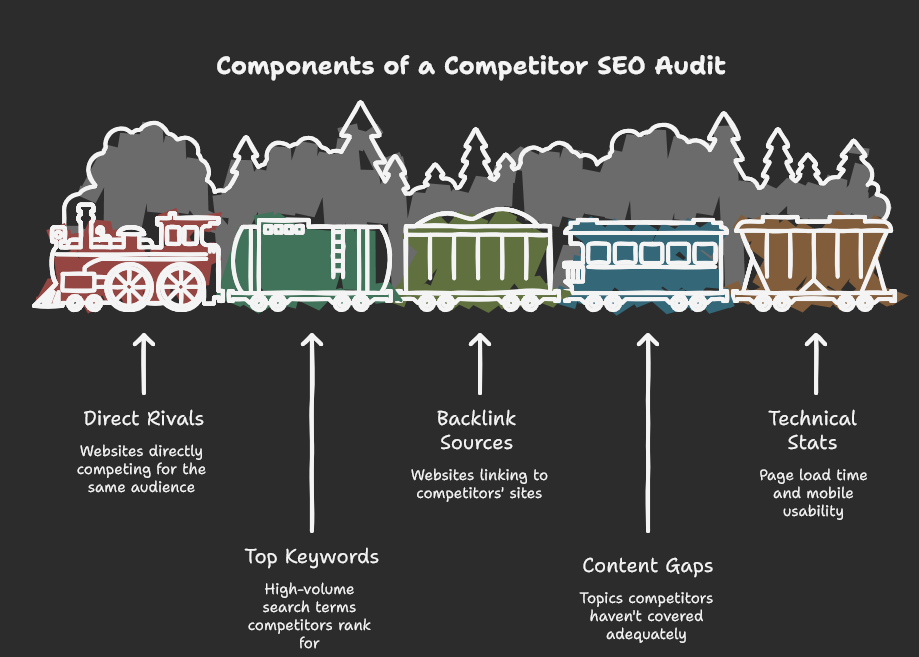
To perform a competitor SEO analysis for free effectively, you need to stay organized. Use a simple spreadsheet to track your findings across these key areas:
- Direct Rivals: List 3–5 websites.
- Top Keywords: 10–20 high-volume terms they rank for.
- Backlink Sources: Top 5 sites linking to them.
- Content Gaps: Topics they’ve covered poorly or not at all.
- Technical Stats: Their average page load time and mobile usability.
By the time you finish this beginner guide to WordPress landing pages and SEO audits, you will have a clear, data-driven plan to improve your own site. You don’t need a massive budget; you just need the discipline to analyze the data that is already available to you.
Growing Your Brand with WP Badgers
At WP Badgers, we know that analyzing your competitors is just the first step. The real challenge is executing a strategy that outperforms them. Based in Noida, we’ve helped over 80+ businesses grow online by turning competitor data into actionable SEO and design plans. Whether you’re struggling to find the right keywords or your technical SEO is holding you back, we provide the expertise needed to turn your website into a lead-generation machine.
If you’re ready to stop guessing and start growing, WP Badgers is here to guide you through every step of the digital journey.
FAQ: Competitor SEO Analysis
1. Is it legal to do competitor SEO analysis?
Yes, absolutely. Competitor SEO analysis involves looking at publicly available data that search engines use to rank websites. As long as you aren’t hacking into private servers or stealing proprietary code, analyzing their keywords and backlinks is a standard and ethical marketing practice.
2. Which is the best truly free tool for SEO analysis?
Google Search Console is the best tool for your own site, but for competitors, Google Keyword Planner and Google PageSpeed Insights are the most reliable free options. For backlink data, Ahrefs’ and Moz’s free limited versions are excellent starting points.
3. How often should I analyze my competitors?
The digital landscape changes quickly. A deep SEO competitor analysis step by step should be done once a quarter. However, you should monitor their social media and brand mentions (via Google Alerts) weekly to stay ahead of new campaigns.
4. Can I outrank a competitor who has a much larger budget?
Yes. Large companies often have “bloated” SEO strategies or slow-moving technical teams. By focusing on niche “long-tail” keywords, providing better user experience (UX), and having faster page speeds, a smaller business can outrank a giant in specific, high-conversion categories.
5. Do I need to know how to code to analyze a competitor’s site?
No. Most free tools for SEO analysis provide a user-friendly interface. While being able to “Inspect Element” helps, you can get 90% of the information you need using browser extensions like SEO Quake or Wappalyzer.
6. How do I find “hidden” competitor keywords?
Look at the comments section of their blog posts and their FAQ pages. Users often ask questions using natural language that doesn’t show up in traditional keyword tools. These are “hidden” keywords that represent high-intent search queries.
7. Why is competitor backlink analysis important?
It shows you the “neighborhood” your competitor lives in. If high-quality, relevant sites trust them, Google will too. By analyzing their backlinks, you find a pre-vetted list of websites that are likely to link to your content as well.
Conclusion
Mastering competitor SEO analysis for free can honestly feel like having a superpower in the digital world. Instead of spending months guessing what might work, you can look at what your competitors are already doing successfully and use that information to build your own strategy.
The first step is figuring out who your real competitors are in search results. They aren’t always the businesses you compete with offline. Once you know who you’re up against, you can dig into the keywords they’re ranking for, see what kind of content is bringing them traffic, and look at their website to find both their strengths and weaknesses.
In 2026, SEO is definitely more competitive than ever. But here’s the good thing: there’s also more data available than ever before. You don’t necessarily need to spend thousands of dollars on expensive SEO tools to understand what’s working. With the right free tools, a little research, and a systematic approach, you can uncover a lot of useful information.
At the end of the day, though, competitor analysis isn’t about simply copying what someone else is doing. It’s about figuring out why their strategy is working and then finding ways to do it better. Maybe their content is more detailed, their website is faster, or they’re answering questions that other sites are completely ignoring.
Think of it this way: your competitors have already spent time testing different strategies and figuring out what works for their audience. You can learn from that experience instead of starting completely from scratch.
So, take the data you find, learn from it, improve on it, and most importantly, give people a better experience and more useful information than the page currently sitting at #1. That’s how you turn competitor SEO analysis into a real advantage.
WordPress SEO services improve website rankings, optimize content, enhance speed, and drive organic traffic to grow your online business visibility.
Contact WP Badgers today for a free SEO consultation. Let’s turn your competitor’s data into your company’s growth. Schedule your free session here.