
Key Takeaways
- E-E-A-T is the Foundation: Experience, Expertise, Authoritativeness, and Trustworthiness are now the primary filters for AI-driven search results.
- GEO is the New SEO: Generative Engine Optimization focuses on making your brand “citeable” by AI chatbots and LLMs.
- Identity Matters: AI search prioritizes verified entities; having a robust Knowledge Graph presence is no longer optional.
- Citations Over Keywords: Being mentioned by reputable third-party sources acts as a “trust vote” that triggers AI recommendations.
- First-Hand Experience Wins: AI models are trained to prioritize “Experience”—content that proves you’ve actually used a product or performed a service.
- Technical Transparency: Structured data (Schema) and clear sourcing are the mechanical ways you communicate trust to AI scrapers.
It used to be pretty simple: you optimized your website for keywords, built a few backlinks, and waited for Google’s blue links to bring in traffic. But in 2026, things have changed—a lot.
The thing is, people aren’t just “searching” anymore. They’re asking questions and prompting AI to find answers for them. Whether they’re using Google’s AI-powered search, Perplexity, or OpenAI’s search tools, the way people discover information has fundamentally changed. And here’s the catch: if an AI system doesn’t trust your brand or see your website as a credible source, you may not show up in the answer at all.
So, the goal today isn’t simply to rank #1 on Google. It’s about becoming the trusted source that AI systems recognize, understand, and feel confident citing when someone asks for a recommendation.
That’s where things like E-E-A-T and Generative Engine Optimization (GEO) come into play. At the end of the day, AI needs signals that tell it your brand knows what it’s talking about. If your business doesn’t have strong digital credentials, clear expertise, and a trustworthy online presence, AI may overlook your brand—or, in some cases, recommend a competitor instead.
In this comprehensive guide, we’ll break down the connection between Google’s E-E-A-T principles and the emerging world of Generative Engine Optimization (GEO). More importantly, we’ll look at practical ways to build strong AI trust signals for your brand, so your business can stay visible, credible, and more likely to be recommended as search continues to move toward an AI-first experience.
1. Understanding the Core: E-E-A-T in the Age of AI
Google’s E-E-A-T (Experience, Expertise, Authoritativeness, and Trustworthiness) was once a guideline for human quality raters. Today, it is the programmatic DNA of the algorithms themselves. AI models are trained on massive datasets, and they are increasingly tuned to filter out “hollow” content.
The “Experience” Multiplier
In 2026, “Experience” is the most critical letter in the acronym. AI can synthesize “Expertise” by scraping a thousand textbooks, but it cannot replicate first-hand, human experience. To build AI content credibility factors, your content must include elements that an AI cannot fake: original photography, personal case studies, and unique data points.
Expertise vs. Information
There is a massive difference between providing information and demonstrating expertise. Information is a commodity; expertise is a perspective. To improve brand trust for AI search, your content must offer a “unique point of view” (UPOV). AI models look for “information gain”—does this page provide something that isn’t already in the training set? If you’re just rephrasing what’s already online, you aren’t an expert; you’re an echo.
The Trustworthiness Anchor
Trustworthiness is the overarching umbrella. It’s about transparency. Is your physical address listed? Are your reviews genuine? Is your “About Us” page detailed or a generic template? For SEO for AI search engines, trustworthiness is quantified through external verification. If the web “talks” about you as a reliable source, the AI listens.
2. Generative Engine Optimization (GEO): The New Frontier
While SEO focuses on clicks, Generative Engine Optimization (GEO) focuses on mentions and citations. GEO is the practice of optimizing your digital footprint so that Large Language Models (LLMs) perceive your brand as the most relevant answer to a prompt.
Optimization for LLM Context Windows
AI models process information in “tokens” and “context windows.” To be featured, your content must be easily digestible for a machine. This means using clear headings, concise summaries, and structured data. When you optimize your WordPress SEO services, you aren’t just helping Google; you are feeding the AI the exact context it needs to categorize your brand.
The Power of “Quotability”
GEO relies heavily on how easily your content can be cited. AI models prefer authoritative statements supported by statistics. If you provide a “stat-heavy” section or a unique “framework,” the AI is more likely to pull that specific snippet into its generated response. This is a core part of an E-E-A-T SEO strategy 2026.
Brand Association Signals
AI builds “word maps” (vectors). If your brand name frequently appears in the same paragraph as keywords like “reliable,” “expert,” or “top-rated,” the AI builds a statistical association between your brand and those positive attributes. GEO involves actively managing these associations through PR, guest posting, and community engagement.
| SEO Element | Traditional SEO Focus | GEO (AI-First) Focus |
| Keywords | Exact match & LSI | Conceptual relevance & Intent |
| Links | PageRank & Authority | Citations & Entity relationships |
| Content | Length & Keyword density | Information gain & Trust signals |
| Structure | User Experience (UX) | Machine Readability (Schema) |
3. How to Build AI Trust Signals for Your Brand
Building AI trust signals for brands isn’t an overnight task. It requires a systematic approach to verifying your brand’s identity across the web. AI models use a process called “entity reconciliation” to determine if “WP Badgers” the website is the same as “WP Badgers” the Google Business Profile.
Establishing Entity Authority
An entity is a “thing” (a person, place, or brand) that an AI recognizes as distinct. To build authority for AI recommendations, you must claim your spot in the Knowledge Graph. This involves:
- Consistent NAP (Name, Address, Phone) across all directories.
- A robust Wikipedia or Wikidata entry (if applicable).
- Active, verified social media profiles that link back to your main entity.
Leveraging Third-Party Validation
AI models don’t just believe what you say about yourself; they look at what others say. High-quality backlinks from niche-relevant, authoritative sites act as trust signals for AI chatbots. A mention on a major industry news site like TechCrunch or a niche-specific blog carries more weight than 100 low-quality links because it validates your entity’s status in the real world.
Actionable Tip: The “Author Persona” Strategy
Don’t publish under “Admin” or “Staff.” Every piece of content should be attributed to a real person with a verifiable digital footprint. Link the author’s bio to their LinkedIn, their personal website, and other platforms where they have contributed. This creates a “trust chain” that AI models can follow to verify expertise.
4. AI Content Credibility Factors: Moving Beyond Text
In 2026, text is easy to generate. Therefore, text alone is a weak trust signal. To truly improve brand trust for AI search, you must incorporate multi-modal elements that prove human oversight and real-world interaction.
The Role of Original Media
Stock photos are a signal of “low effort” to modern AI filters. To how to build AI trust signals, use original photography, behind-the-scenes videos, and custom infographics. When an AI “sees” (through Alt text and computer vision) that your images are unique to your site, it assigns a higher “Experience” score to your content.
Data-Driven Content and Research
If you want to be cited, you must be the source. Conduct surveys, analyze your internal data, and publish original reports. For example, a WordPress agency might publish a “State of Site Speed in Noida 2026” report. This original data becomes a magnet for AI trust signals because other sites will cite your data, and AI models will attribute that data to you.
User Sentiment and Reviews
AI models scrape review platforms like G2, Capterra, Trustpilot, and Google Maps. They don’t just look at the star rating; they perform sentiment analysis on the text. If users frequently mention your “technical expertise” or “fast response time,” the AI incorporates those phrases into its summary of your brand.
- Encourage Specificity: Ask clients to mention specific services in reviews.
- Respond to All Feedback: Showing active management demonstrates a “living” and trustworthy entity.
- Monitor Niche Forums: Mentions on Reddit or Quora are heavily weighted by AI models like Perplexity.
5. Technical Foundations: Schema and Machine Readability
If E-E-A-T is the “soul” of your strategy, Schema Markup is the “skeleton.” You cannot have a successful E-E-A-T SEO strategy 2026 without a flawless technical setup that tells the AI exactly what it’s looking at.
Advanced Schema Implementations
Basic “Organization” schema isn’t enough. You need to use specific types to define your brand’s relationships:
sameAsProperty: Link your website to your social profiles and Wikipedia pages.authorandreviewedBySchema: Formally declare who wrote the content and who verified it.CitationSchema: Explicitly list your sources to show you’ve done your research.
Optimizing for “Snippetability”
AI search engines often pull “blocks” of content. To win these slots, use a “Summary-First” approach. Start your H2 or H3 sections with a direct, 40–50 word answer to the primary question. This makes it incredibly easy for an AI to scrape your content as a “Featured Snippet” or an “SGE Answer.”
Improving Site Speed and Core Web Vitals
While it seems like an old-school SEO metric, technical performance is a baseline trust signal. A site that is slow or broken is perceived as “unmaintained.” AI models, which value efficiency, are less likely to direct users to a frustrating technical experience. Ensure your WordPress site is optimized for the latest Google E-E-A-T guidelines.
6. Developing an E-E-A-T SEO Strategy for 2026
The transition from 2024 to 2026 has seen a total shift in how we approach content calendars. It’s no longer about volume; it’s about “Authority Clusters.”
Topical Authority Mapping
To build authority for AI recommendations, you shouldn’t write random blog posts. You need to “own” a topic. Create a pillar page that covers a broad subject (e.g., WordPress Security) and surround it with dozens of H3-level posts that cover every possible micro-question. This tells the AI that you are the comprehensive expert in this specific niche.
Content Refreshing as a Trust Signal
Information decays. An AI model is less likely to trust a “Guide to SEO” written in 2023. A core part of your strategy must be “Recursive Optimization”—going back to old content and updating it with the latest 2026 data. This signals to the AI that your brand is active and that your expertise is current.
WordPress SEO services help optimize your website to rank higher in search engines, drive organic traffic, and improve user experience. These services include keyword optimization, technical SEO, speed improvements, on-page enhancements, and content strategy to ensure your WordPress site performs well and attracts the right audience.
Real-World Example: The “Noida Business” Case Study
Imagine a local real estate firm in Noida. To build AI trust signals for brands, they shouldn’t just list properties. They should:
- Publish monthly market reports on specific Noida sectors (Expertise/Data).
- Interview local urban planners on video (Authority).
- Include 360-degree virtual tours they filmed themselves (Experience).
- Maintain a verified Google Business Profile with 100+ detailed reviews (Trust).When someone asks SearchGPT, “What’s the best area to invest in Noida?”, this firm becomes the logical, trusted answer.
7. How GEO and E-E-A-T Work Together
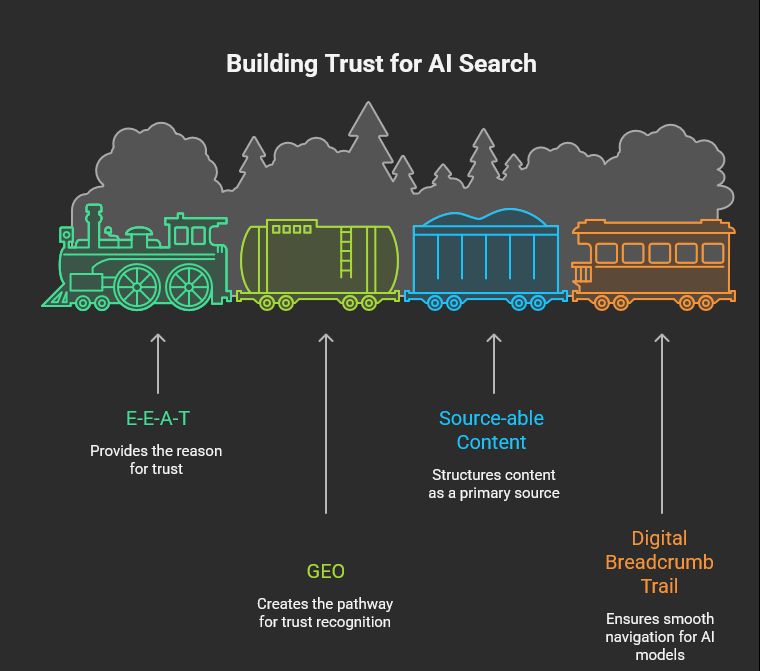
It is a mistake to view GEO and E-E-A-T as separate tasks. They are two sides of the same coin. E-E-A-T provides the reason for trust, while GEO provides the pathway for that trust to be recognized by AI.
Creating “Source-able” Content
To improve brand trust for AI search, your content must be structured to be a primary source. This means avoiding “weasel words” (like “some people say”) and using definitive, expert-led statements. When you provide a clear, original framework—for example, the “WP Badgers 5-Step Trust Audit”—you are creating a GEO-friendly asset that AI models can easily cite by name.
Building the Digital Breadcrumb Trail
AI models follow paths. They start with a user query, look for entities, check those entities’ credentials (E-E-A-T), and then look for the most citeable content (GEO). Your job is to ensure there are no “broken links” in this trail.
- Step 1: Verify your identity (Schema/Knowledge Graph).
- Step 2: Prove your knowledge (Expert-led content).
- Step 3: Get third-party validation (Backlinks/Reviews).
- Step 4: Format for AI (GEO/Structuring).
The Future of AI Search: Personalization
By 2026, AI search is also becoming highly personalized. Trust signals will soon include “user affinity.” If a user has interacted with your brand before or if their “trusted circle” has, the AI will prioritize you. Building a loyal community via email and social media now feeds directly into your AI search visibility later.
8. Avoiding AI Trust Pitfalls
In the rush to optimize, many brands fall into traps that actually destroy their AI content credibility factors.
The Danger of 100% AI-Generated Content
If an AI can write your entire blog post with a single prompt, so can your competitor. More importantly, AI models are increasingly able to detect “synthetic patterns.” If your site is 100% AI-generated without human editing or original insights, your E-E-A-T score will plummet. Use AI as a tool for research and outlining, but the final “Experience” and “Expertise” layers must be human.
Ignoring Local Trust Signals
For businesses in specific regions, like Noida or Delhi, local trust signals are paramount. AI models are very good at “Geo-fencing.” If you claim to be a Noida agency but have no local citations, local news mentions, or local addresses, the AI will flag you as untrustworthy for local queries.
Over-Optimization (GEO Spam)
Just as keyword stuffing killed SEO in the 2010s, “Citation stuffing” or fake review loops will kill your GEO efforts in 2026. AI models are trained to spot unnatural patterns. Focus on how to build AI trust signals through genuine authority rather than trying to “game” the LLM.
Scaling Your Trust with WP Badgers
Navigating the complexities of E-E-A-T and GEO for AI trust signals requires a partner who understands the shifting sands of the 2026 digital landscape. At WP Badgers, we specialize in bridge-building—connecting your brand’s real-world expertise to the technical requirements of modern AI search engines. With a track record of helping over 80+ businesses grow online, we ensure your WordPress site isn’t just a static page, but a high-authority entity that AI models trust and recommend.
Ready to dominate the generative search era? WP Badgers is here to help you build a future-proof digital presence.
FAQ: E-E-A-T and GEO for AI Trust Signals
1. What is the main difference between SEO and GEO?
Traditional SEO focuses on optimizing for search engine algorithms to rank higher in blue-link results. GEO (Generative Engine Optimization) focuses on optimizing content so that AI models (like ChatGPT or SGE) perceive your brand as a trusted authority and cite it directly in their generated answers.
2. How does Google’s E-E-A-T impact AI search rankings?
AI models use E-E-A-T as a framework to evaluate the quality of information. Content that shows real-world Experience and Expertise is prioritized because it offers “information gain” that simple AI-generated text cannot replicate, making it more reliable for AI-driven recommendations.
3. Can AI-generated content still have high E-E-A-T?
Yes, but only if it is heavily edited and augmented by a human expert. To maintain AI content credibility factors, you must add original data, personal anecdotes, and unique insights that a base AI model wouldn’t know, proving the “Experience” component of E-E-A-T.
4. Why is Schema markup important for GEO?
Schema markup acts as a translator between your website and an AI model. It provides structured data that defines your “Entity” (who you are), your authors (their expertise), and your relationships, making it much easier for AI to verify your AI trust signals for brands.
5. How do reviews affect my brand’s visibility in AI chatbots?
AI chatbots perform sentiment analysis on third-party reviews. Positive, detailed reviews that mention specific services or expertise act as a “trust vote.” If the consensus across the web is that your brand is reliable, AI models are significantly more likely to recommend you.
6. What are the most important trust signals for AI search engines?
The most important signals include verified entity status (Knowledge Graph), high-quality citations from reputable news or niche sites, original multi-modal content (video/photos), and a clear, consistent digital footprint across social media and professional directories.
7. How often should I update my content for E-E-A-T in 2026?
In the fast-moving AI landscape, “freshness” is a trust signal. You should audit and update your high-authority content at least every 6 months. This ensures your data is current and signals to AI scrapers that your brand is an active, reliable source of truth.
Conclusion: Dominating the Future of Search
The era of “tricking” search engines is pretty much over. In 2026, if you want to stay visible online, you have to actually build trust. It’s not just about trying to please an algorithm anymore. By focusing on E-E-A-T and GEO to strengthen AI trust signals, you’re building a brand that can stay strong even as search keeps changing.
Think about it this way: AI search engines are trying to make recommendations the way people do. They want to surface businesses, websites, and content that seem genuinely experienced, credible, and trustworthy-not pages that are simply stuffed with keywords.
So, what should you focus on? First, create content that actually helps people and gives them something useful. Make it clear who you are, show your real experience, and use technical SEO and Schema to help search engines understand your business and expertise. You should also build what I’d call a “web of trust” through genuine reviews, third-party mentions, citations, and other reputable websites talking about your brand.
At the end of the day, the shift toward AI-powered search isn’t something to be afraid of. Honestly, it can be a great opportunity. Brands that consistently provide useful information, demonstrate real expertise, and earn people’s trust have a much better chance of standing out from all the generic, low-effort content online.
Contact WP Badgers today for a free SEO consultation and let us help you build a WordPress SEO strategy that wins in the age of AI.