
Key Takeaways
- Capture Zero-Click Searches: People Also Ask (PAA) boxes show up in a large share of Google search results, so they’re definitely worth paying attention to. Even if someone doesn’t click on your website, getting your answer featured in a PAA box can put your brand directly in front of them and increase visibility.
- Structure Your Content for Success: A simple approach is to turn your H2 and H3 headings into actual questions your audience is asking. Then, answer each question clearly and directly right underneath it. Keeping the initial answer concise—around 40–60 words—can make it easier for Google to understand and potentially use your content in a PAA result.
- Find the Questions People Actually Ask: Don’t just guess what your audience wants to know. Tools like Semrush and AnswerThePublic can help you discover the questions and phrases people are searching for in your industry. Once you know those questions, you can create content that answers them naturally.
- Use Schema Markup Where It Makes Sense: Adding structured data, such as FAQ or HowTo schema when appropriate, can help search engines better understand your content. It doesn’t guarantee a PAA placement, but it can make your page’s information easier for search engines to interpret.
- Take Advantage of Related Questions: PAA results are dynamic and often lead users to additional related questions. If your content answers several closely connected questions well, your brand may have more opportunities to appear across related searches. Think of it as building visibility one useful answer at a time.
- Optimize Content You Already Have: You don’t always need to publish a brand-new article to target PAA results. Sometimes, your existing pages are already ranking well but simply aren’t structured around the questions users are asking. Reworking those pages with clear question-based headings and concise answers can be a quick and practical way to improve your chances of earning additional search visibility.
People Also Ask Optimization: Win Featured Answers on Google
Did you know that more than 50% of Google searches now end without the user clicking through to a website? This is what people often call the “zero-click” search, and it’s largely driven by the different features Google displays directly on the search results page. One of the most noticeable is the People Also Ask (PAA) box. If your website isn’t showing up there, you could be missing out on a valuable piece of search visibility while your competitors take up that space.
And with AI-powered answers becoming a bigger part of how people search, People Also Ask optimization is no longer something you can simply treat as an optional extra. It’s becoming an important part of a well-rounded SEO strategy.
Here’s the tricky part: you might already rank on the first page of Google and still struggle to get noticed. Why? PAA boxes, featured snippets, maps, videos, and other SERP features can push traditional organic listings farther down the page. In this guide, we’ll break down how Google chooses answers for People Also Ask, look at practical Google PAA SEO strategies, and explain how to optimize your content for featured answers. We’ll also walk through a step-by-step framework for improving your chances of appearing in Google’s People Also Ask results.
By the end, you’ll have a practical roadmap for turning your existing content into clear, useful answers that address the questions your audience is actually asking—and give your brand more opportunities to show up when those searches happen.
Understanding the Mechanics of the PAA Box
Before you can master how to optimize for People Also Ask, you must understand how this feature functions. Unlike a standard featured snippet, which usually appears at the very top, PAA boxes can appear anywhere on the first page. They are dynamic; clicking one question often triggers three or four more to appear, creating an almost infinite list of related queries.
The Algorithm Behind the Questions
Google uses sophisticated Natural Language Processing (NLP) to determine which questions are contextually relevant to a user’s initial search. These aren’t just random questions; they are based on massive datasets of user behavior. When you focus on PAA box ranking techniques, you aren’t just chasing a keyword—you are attempting to satisfy a specific user intent.
Why PAA Matters More Than Traditional Rankings
Traditional organic rankings are becoming increasingly crowded. However, the PAA box offers a shortcut. A site ranking in position #8 can often jump to the “top” of the user’s eye line by winning a PAA answer. This provides a unique opportunity for smaller brands to outmaneuver industry giants by providing clearer, more direct answers.
The Lifecycle of a PAA Result
A PAA result is not static. Google constantly tests different sources to see which one provides the best user satisfaction (often measured by dwell time or the lack of further searching). This means your SEO for featured snippets and PAA must be consistently updated to maintain its spot.
3. How to Identify High-Value PAA Opportunities
Winning at question-based SEO optimization starts with research. You cannot guess what users are asking; you must look at the data. Identifying the right questions ensures that your optimization efforts are focused on queries that actually drive business value.
Mining the SERP for “Seed” Questions
The simplest way to start is by searching for your primary keywords and looking at the PAA box that appears. Take note of the questions, the format of the answers (paragraphs, lists, or tables), and the domains currently holding those spots. This is the foundation of a successful Google PAA SEO strategy.
Using Advanced Keyword Research Tools
Tools like Semrush, Ahrefs, and AnswerThePublic are invaluable for improving visibility in PAA results. These tools allow you to filter keywords specifically by “SERP Features.” Look for keywords that have a high search volume and already trigger a PAA box. These are your prime targets.
Analyzing Intent Categories
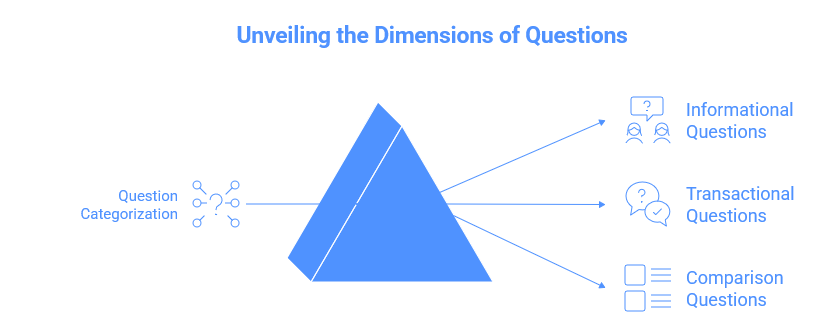
Not all questions are created equal. You should categorize your identified questions into three main buckets:
- Informational: “What is…” or “How does…”
- Transactional: “How much does… cost?” or “Where can I buy…”
- Comparison: “Difference between X and Y” or “Is X better than Y?”
| Goal | Strategy | Content Type |
| Brand Awareness | Target broad informational “What is” queries | Detailed Blog Posts / Glossaries |
| Lead Generation | Target “How to” and “Tutorial” queries | Step-by-Step Guides |
| Conversion | Target pricing and comparison queries | Comparison Tables / Pricing Pages |
4. Content Formatting for Featured Answers
Google’s crawlers are looking for content that is easy to extract. To rank in Google People Also Ask, your content must be structured in a way that “hands” the answer to Google on a silver platter. This is the core of featured answers optimization.
The “Question-Answer” Header Technique
A highly effective PAA box ranking technique is to use your H2 or H3 tags as the literal question you want to rank for. Immediately following that header, provide a concise answer in a single paragraph. This paragraph should ideally be between 40 and 60 words. This format makes it incredibly easy for Google to identify your text as a candidate for the PAA box.
The Power of Lists and Tables
Google loves structured data. If a question is better answered by a list (e.g., “Steps to install WordPress”) or a table (e.g., “WordPress.com vs WordPress.org pricing”), use those formats. Use <ul> or <ol> tags for lists and proper <table> HTML tags. Google often pulls these directly into the PAA box, providing a much cleaner user experience than a wall of text.
Actionable Tip: The “Inverted Pyramid” Style
When writing your answer paragraph, put the most important information first. Start with the direct answer, then provide context or supporting details. This mirrors the journalistic “inverted pyramid” style and aligns perfectly with how Google’s AI summarizes content for Google SERP features optimization.
5. Technical SEO: Schema and Site Structure
While great writing is essential, technical SEO provides the bridge between your content and Google’s algorithm. To truly excel at SEO for featured snippets and PAA, you must ensure your technical foundation is rock solid.
Implementing FAQ Schema
FAQ Schema is a specific type of structured data that tells Google, “This section contains questions and answers.” By wrapping your PAA-targeted content in JSON-LD FAQ schema, you increase the likelihood of Google recognizing and featuring your content. This is a critical component of how to get featured answers on Google.
Improving Page Speed and Mobile Friendliness
PAA results are heavily skewed toward sites that provide a great mobile experience. Since many PAA interactions happen on mobile devices, a slow-loading page or a poorly formatted mobile site can disqualify you from the PAA box, even if your content is perfect. Focus on Core Web Vitals to ensure your site is technically eligible.
Internal Linking and Topical Authority
Google prefers to pull PAA answers from sites it considers “authorities” on a topic. You can build this authority by using a “hub and spoke” internal linking model. Link your PAA-optimized blog posts to your main service pages. For example, if you are discussing WordPress optimization, ensure you link back to your WordPress SEO services page to signal to Google that you have deep expertise in this niche.
6. How to Optimize Existing Content for PAA
You don’t always need to create new content to win at People Also Ask optimization. In fact, some of your quickest wins will come from updating older posts that are already on the first or second page of Google.
Audit Your High-Ranking Pages
Identify pages that rank in positions 1–10. These are your best candidates because Google already trusts these pages. Use a tool like Search Console to see what long-tail questions are driving “impressions” to these pages, even if they aren’t driving clicks yet.
Inserting “PAA Magnets”
A “PAA Magnet” is a section added to an existing post specifically designed to answer a common question. If you have a blog post about “WordPress Maintenance,” add a section titled “How often should I update WordPress plugins?” and follow the 40–60 word answer rule. This simple addition can trigger a new PAA feature for an old post within days.
Real-World Example: The “VS” Strategy
Many businesses miss out on “comparison” PAA boxes. If you have a service page, add a comparison section (e.g., “Service A vs. Service B”). We recently helped a client implement this by adding a simple comparison table to their landing page. Within three weeks, they captured the PAA box for three major competitor-comparison queries, leading to a 15% increase in organic leads.
7. Advanced Google PAA SEO Strategy: The Infinite Loop
Once you’ve mastered the basics of how to optimize for People Also Ask, you can begin to leverage the “Infinite Loop” effect. This is where your brand appears in multiple related PAA questions within the same search session.
Mapping Question Clusters
Questions in the PAA box aren’t isolated; they follow a logical progression. If someone asks “How to start a blog,” the next questions are likely “How much does a blog cost?” and “How do bloggers make money?” By mapping these clusters, you can create a single long-form guide that answers 5–10 related questions, effectively “owning” the entire PAA thread.
Monitoring and Iteration
The SERP is a living organism. Competitors will try to “steal” your PAA spot by providing a more updated or concise answer. You must monitor your PAA rankings regularly. If you lose a spot, analyze the new winner. Is their answer shorter? Is it more recent? Do they use a table where you used a paragraph? Adjust your content accordingly to win it back.
Improving Visibility in PAA Results via Multimedia
Sometimes, Google prefers a video or an image for a PAA answer, especially for “How-to” queries. Including a well-optimized YouTube video or a high-quality infographic with descriptive Alt Text (like “People Also Ask optimization tips”) can help you capture these visual PAA slots that text-only competitors miss.
8. Measuring the Success of Your PAA Efforts
How do you know if your Google SERP features optimization is actually working? Since PAA clicks aren’t always explicitly labeled in Google Analytics, you need to look at specific metrics.
Tracking Impressions and CTR in Search Console
While GSC doesn’t have a “PAA Filter,” you can look for queries that are phrased as questions. If you see a spike in impressions for these questions but the average position is high (e.g., position #1), it’s a strong indicator that you are appearing in a PAA box or a Featured Snippet.
Using Third-Party Rank Trackers
Tools like ProRankTracker or Nightwatch can specifically track “SERP Feature” ownership. They will show you a small icon next to your keyword if you own the PAA box. This is the most accurate way to measure your featured answers optimization success over time.
The Correlation with “Assisted Conversions”
Even if a user doesn’t click your PAA result, they see your brand name. This builds trust. Often, we see that a heavy presence in PAA boxes leads to an increase in “Direct” traffic or “Branded Searches” later on. Users remember you as the authority that provided the answer they needed.
9. Common Mistakes to Avoid in PAA SEO
Even experienced SEOs make mistakes when it comes to PAA box ranking techniques. Avoiding these pitfalls will save you time and ensure your rankings are durable.
- Being Too Wordy: If your answer is 150 words long, Google won’t pull it. Keep it under 60 words for the direct answer section.
- Ignoring the Context: Don’t just answer the question; ensure the rest of the page provides deep value. Google looks at the overall quality of the page, not just the snippet.
- Using Non-Standard HTML: Stick to clean, semantic HTML. Avoid complex JavaScript accordions for your Q&A sections if they hide content from crawlers.
- Forgetting Mobile Users: If your PAA answer links to a page that isn’t mobile-friendly, Google will quickly replace you with a better alternative.
10. Summary Checklist for PAA Dominance
To ensure you have covered all bases for People Also Ask optimization, follow this final checklist for every piece of content you publish:
- Identify 3–5 core questions using PAA boxes and keyword tools.
- Use H2 or H3 tags for these exact questions.
- Write a 40–60 word direct answer immediately following the header.
- Incorporate a list or table if it clarifies the answer.
- Apply FAQ Schema markup to the page.
- Add internal links to relevant service pages or high-authority pillars.
- Optimize images/videos within the section for visual PAA opportunities.
Why Choose WP Badgers for Your SEO?
Navigating the complexities of Google SERP features optimization can be overwhelming for busy business owners. At WP Badgers, we specialize in turning WordPress sites into high-performance growth engines through advanced SEO and strategic design. We have helped over 80 businesses grow online by capturing high-value search real estate just like the PAA box.
Frequently Asked Questions (FAQ)
What is People Also Ask optimization?
People Also Ask optimization is the process of structuring your website’s content to appear in the Q&A boxes on Google’s search results pages. It involves identifying common user questions, providing concise and direct answers, and using technical tools like FAQ Schema to help Google’s algorithm recognize your expertise.
How do I rank in Google People Also Ask?
To rank in Google People Also Ask, you should use questions as headers (H2 or H3) and provide a clear, 40–60 word answer immediately below. Utilizing structured data, maintaining high topical authority, and ensuring your site is mobile-friendly are also critical factors for winning these spots.
Are PAA results different from Featured Snippets?
Yes. A Featured Snippet is usually a single “Position Zero” result at the top of the SERP. PAA boxes are multiple, expandable questions that can appear anywhere on the page. However, the strategies for SEO for featured snippets and PAA are very similar, focusing on directness and structure.
Does FAQ Schema help with PAA rankings?
While FAQ Schema isn’t a guaranteed “ranking factor,” it significantly helps Google understand the structure of your Q&A content. By making your data more accessible to crawlers, you increase the chances of being selected for featured answers optimization and other rich results.
How long should a PAA answer be?
The ideal length for a PAA answer is between 40 and 60 words. Google’s algorithm prefers snippets that are long enough to be helpful but short enough to be read quickly on a mobile screen. If your answer is too long, it may be truncated or ignored.
Can I win PAA spots for my competitors’ brand names?
Yes, you can. By creating comparison pages (e.g., “Your Brand vs. Competitor Brand”) and answering questions about their pricing or features objectively, you can capture Google PAA SEO strategy opportunities that appear when users search for your competitors.
How often do PAA questions change?
PAA questions are highly dynamic and can change based on real-time search trends and user behavior. To improve visibility in PAA results, you should regularly audit your key pages and update your answers to reflect the most current and accurate information available.
Conclusion
Mastering People Also Ask optimization can be a really effective way to expand your online visibility in 2026. As Google continues to move toward becoming more of an “answer engine,” being able to provide clear, helpful, and trustworthy answers to the questions people are searching for can make a big difference to your SEO strategy. By building a solid Google PAA SEO strategy—from researching the right questions and writing concise answers to using relevant schema markup—you can create more opportunities to get your content in front of the right audience. This is especially useful for businesses that want to educate potential customers, whether they’re researching SEO services or learning how to create ecommerce website on WordPress.
And here’s the thing: the “zero-click” era doesn’t necessarily mean zero value or zero traffic. When your content appears in Google People Also Ask, your brand can build familiarity and credibility with searchers before they ever visit your website. Think of it as getting your expertise in front of potential customers earlier in their search journey. SEO is still a marathon, not a sprint, so keep monitoring your results, updating your answers, and refining your featured answers optimization over time. That consistent effort can help you stay visible as Google and search behavior continue to change.
Ready to dominate the SERPs and capture more featured answers? Contact WP Badgers today for a free SEO consultation and let us help you implement a winning WordPress SEO Services strategy for your business.