
Key Takeaways
- The Death of Simple Clicks: The reality is, getting a click from Google isn’t as easy as it used to be. Organic click-through rates are dropping—by as much as 61% for some informational searches—because AI can now give people the answer right on the search results page. In other words, users don’t always need to visit a website anymore.
- Source-Worthiness Is the New Ranking Factor: It’s not just about having a strong backlink profile anymore. Search engines and generative AI systems are looking for sources they can actually trust. That means your content needs to be clear, accurate, well-structured, and genuinely helpful for the specific question someone is asking. Basically, if your website looks like a reliable source, you have a better chance of being referenced in AI-generated answers.
- E-E-A-T Is the Foundation: If you want your content to get noticed and cited by AI, you need to show that you actually know what you’re talking about. Real-world experience, qualified authors, clear credentials, original research, and firsthand insights are becoming more important than ever. Simply publishing another generic article isn’t going to cut it.
- Modular Content Is Becoming Essential: Here’s the thing: AI systems need to understand and process your content quickly. That’s why breaking your content into clear headings, short answer sections, bullet points, tables, and easy-to-scan sections is so important. Think of it as making your content easier for both people and AI to understand.
- Zero-Click Search Requires a Different Conversion Strategy: When people can get an answer without leaving Google, traditional traffic-focused SEO isn’t enough anymore. You need to think beyond rankings and clicks. The goal is to build a recognizable, trustworthy brand and give people a strong reason to visit your website when they’re ready to take action. At the end of the day, getting fewer clicks isn’t necessarily a problem if the clicks you do get come from people who are genuinely interested and ready to convert.
The Genesis of AI-First Search and the Evolution of Google SGE
The digital landscape has reached a pretty important turning point. For more than two decades, SEO followed a fairly simple and predictable pattern: someone would type a keyword into Google, Google would show a list of search results, and the user would click on a website to find the information they were looking for.
And, honestly, that model worked really well for a long time.
But things are changing—and they’re changing fast.
With the rise of generative AI, Google is moving away from simply showing users a list of websites and is starting to answer their questions directly on the search results page. Instead of making people visit several websites and dig through different pages to find the right information, Google can now understand the context of a query, pull information from multiple sources, and generate a useful answer almost instantly.
The thing is, this shift didn’t happen overnight.
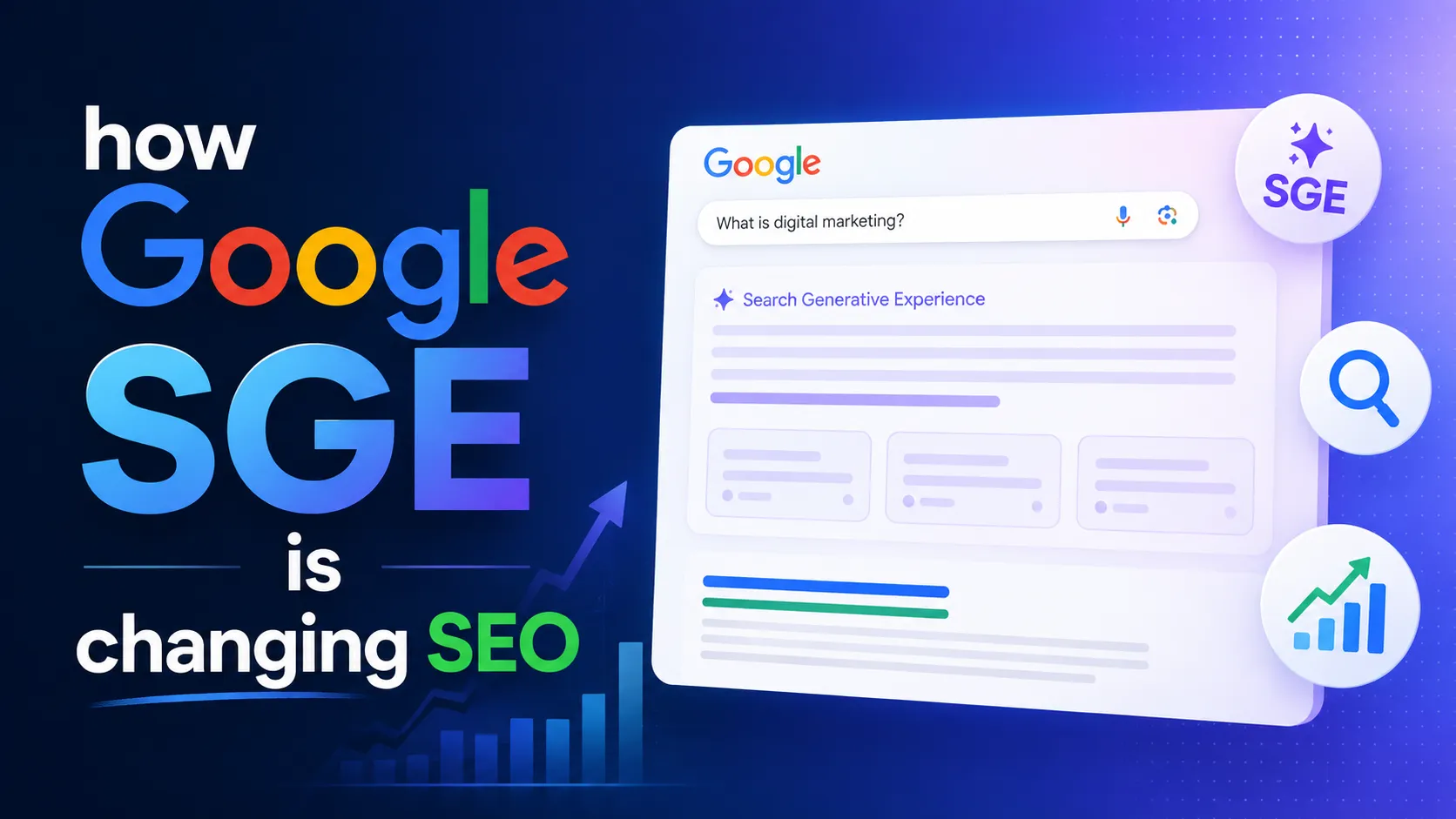
It started with Google’s Search Generative Experience (SGE). Over time, that technology evolved into what we now know as AI Overviews, Google’s AI-powered approach to delivering information directly within search results.
Basically, AI Overviews uses advanced AI and search technologies to understand what someone is actually looking for, identify relevant and trustworthy sources, and bring the most useful information together into a summarized answer. That answer can then appear near the top of the Search Engine Results Page (SERP).
And this is where things get really interesting-and important-for digital marketers, SEO agencies, and businesses.
This isn’t just another Google algorithm update that you can tweak your strategy for and then move on. It represents a much bigger change in the way online visibility works.
Think about it this way: if your business depends on organic search to generate leads, sell products, attract customers, or build brand authority, you can’t really afford to ignore Google SGE SEO and the broader shift toward AI-powered search.
The way people search is changing, and Google is changing the way it delivers information in response.
For years, the basic SEO approach was pretty straightforward: target the right keywords, rank as high as possible, get the click, and bring the visitor to your website.
But now, that’s not necessarily enough.
A user might search for something, get an AI-generated answer right at the top of Google, and never click through to a traditional search result at all.
That’s the big shift.
And that’s exactly why understanding how generative AI in SEO works has become so important.
In this guide, we’ll break down how Google’s AI-powered search experience works, what the data tells us about its impact on organic traffic and online visibility, and-most importantly-what you can actually do to adapt your SEO strategy.
Because at the end of the day, the goal isn’t simply to keep ranking for keywords.
The goal is to make your website and your brand valuable enough that AI-powered search systems can understand, trust, and potentially surface your content when people are looking for answers.
So, let’s take a closer look at what’s changing, why it matters, and how you can stay competitive in this new era of search.
How Google Search Generative Experience Works Technically
To optimize content for an artificial intelligence system, you must first understand the backend engineering that powers it. The Google Search Generative Experience does not simply scrape a single page and paste the text into a summary block. Instead, it utilizes a sophisticated multi-step retrieval and processing pipeline driven by Google’s advanced large language models (LLMs), including the Gemini architecture.
When a user submits a query—particularly a long-tail, conversational phrase—the search engine bypasses the traditional simple keyword-matching process. Instead, the pipeline executes the following distinct technical stages:
- Intent Decoding: The LLM analyzes the semantic structure of the search query to extract core thematic requirements, contextual modifiers, and implicit user goals.
- Multi-Source Retrieval: The underlying search algorithm performs a massive, rapid parallel index sweep to isolate a cohort of highly relevant, technically sound, and trusted URLs that address the specific facets of the user’s intent.
- Retrieval-Augmented Generation (RAG): The selected content fragments are fed into a secured, specialized context window where the AI reads, interprets, and cross-references the technical data from multiple web pages.
- Synthesis and Citation Generation: The AI writes a fluid, context-aware, original response block while simultaneously appending explicit digital tracking links and carousel cards pointing directly to the exact source pages that verified the facts.
The Role of LLMs and Semantic Mapping
Traditional algorithms relied heavily on lexical matching—ensuring the words on your page matched the exact characters typed into the search bar. The new era of AI search optimization relies almost exclusively on semantic vector mapping. The AI reads content like a human editor, analyzing paragraphs for thematic completeness, topical authority, and factual logic. If a page contains superficial fluff written purely to trigger traditional keywords, the generative model will systematically filter it out of the RAG context window, rendering the page entirely invisible to the AI summary.
The Core Architecture of AI Overviews
The user-facing interface of an AI Overview consists of several vital elements that you must optimize for. First is the Generative Summary Block, which contains multi-paragraph direct answers to the user’s query. Branching off this block are In-Text Citation Chips, which act as inline footnotes linking back to specific websites. To the side or directly beneath the text sits the Source Link Carousel, displaying highly prominent visual cards of the cited domains.
Understanding how these elements are constructed allows us to build an SEO strategy for AI search that ensures your site gets pulled into the citation layer rather than buried underneath it.
The Death of the Click? Analyzing the Data Behind Declining CTR
The single biggest point of anxiety within the digital marketing community regarding Google AI search is the undeniable reduction in organic click-through rates. When a user can find an exact, fully fleshed-out answer to their question directly on the Google search interface without opening a new tab, their motivation to click on a standard search result drops precipitously. This phenomenon is known as the rise of zero-click searches.
Data from extensive industry studies tracking millions of search queries since the global expansion of AI Overviews paint a stark picture for websites relying on informational search traffic.
| Query Classification | Traditional Position #1 Avg CTR | Estimated AI-First SERP Position #1 CTR | Average Percentage Reduction |
| Simple Informational (e.g., “What is the capital of India”) | 32.4% | 4.2% | ~87% |
| Complex Informational (e.g., “How to fix a leaky pipe step by step”) | 28.9% | 11.2% | ~61% |
| Commercial Investigation (e.g., “Best WordPress hosting for agency 2026”) | 22.1% | 15.4% | ~30% |
| Transactional / Local (e.g., “SEO agency in Noida contact”) | 18.5% | 16.2% | ~12% |
Why Informational Content Strategy Must Pivot
As the data shows, simple definition-based keywords and basic factual searches are seeing a pretty dramatic drop in organic traffic. So, if your website strategy still depends heavily on short, low-effort blog posts that mainly define basic terms, your traffic could be pretty vulnerable right now.
But that doesn’t mean content marketing is dead. Not at all. It just means the goal of content marketing is changing.
Think about it this way: AI can easily answer simple questions and give users quick definitions, so there’s less reason for someone to click through to a website for that kind of information. But when people have more complicated questions—ones that require real comparisons, expert opinions, detailed explanations, or strategic guidance—that’s where there’s still a big opportunity.
And here’s the interesting part: when AI puts together an answer for a more complex query, it often pulls information from multiple sources and shows those sources as citations or carousels. People who want a deeper, more complete answer may actually use those links to dig further.
In other words, being cited by AI can become a new way to earn qualified traffic. If your content is genuinely useful, well-researched, and provides something beyond a basic definition, those citation links can act almost like trusted recommendations. And when users land on your site with a specific question or problem already in mind, they’re generally more likely to engage with the content instead of simply clicking away.
So, the takeaway is pretty simple: don’t stop creating content—start creating better content. Focus less on answering questions that AI can handle in a sentence or two, and more on topics where people actually need expertise, context, comparison, and a thoughtful point of view.
Adapting to the New Reality
To make up for the drop in traditional organic clicks, your content needs to become one of those trusted sources that AI platforms actually cite and rely on. In other words, you’ll need to shift your KPIs away from vanity metrics like search impressions and start paying more attention to things that really matter—like visibility in AI search results, how often your brand gets mentioned positively in AI-generated answers, and how much your content helps drive actual conversions.
Demystifying Source-Worthiness: How the AI Decides to Cite You
In the traditional framework of search engine optimization, the primary currency of ranking authority was the backlink. A high volume of links from external domains pointing to your page signaled to the search engine that your site was important. While links still play an underlying role in domain validation, the generative selection process uses an entirely different metric of evaluation: Source-Worthiness.
[Traditional SEO: Links + Keywords] ──► Determines Domain Trust
                                               │
[AI Overviews: Semantic Match + E-E-A-T] ──────┴──► Source-Worthiness Citation
Source-worthiness defines a page’s structural, factual, and experiential capability to serve as a verifiable reference for an AI-generated answer. The AI’s greatest vulnerability is the tendency to hallucinate incorrect information. To protect its brand integrity, Google’s RAG pipeline aggressively prioritizes web pages that offer absolute factual accuracy, clear structure, and unshakeable authority.
The Breakdown of AI Content Selection Criteria
When the generative model processes a pool of potential web pages to cite within an overview, it measures the content across several specific performance benchmarks:
- Granular Intent Alignment: Does the text offer a precise, unambiguous resolution to the exact conversational modifiers within the user’s prompt?
- Information Density: Is the page packed with high-value, actionable insights, or is it padded with repetitive, low-value introductory text?
- Structural Scannability: Can the AI’s parser easily break down the text into semantic fragments (tables, ordered lists, explicit definition blocks)?
- Verifiable Factual Integrity: Are the statistics, data points, and claims on the page backed by references, original research, or highly trusted industry databases?
The Myth of the Rank #1 Citation
One of the most interesting things we’ve seen while tracking SEO for SGE is that the pages featured in the AI Overview carousel don’t always come from the traditional top 3 organic results. In fact, research shows that quite often, one or even two of the sources cited in an AI-generated summary can come from pages ranking somewhere between positions 4 and 11.
And honestly, that’s where things get pretty interesting. A page sitting at position 8 might not have as many backlinks or as much authority as the site ranking at number 1, but if its content is well-structured, gives clear and direct answers, and provides useful, data-rich information, it can still be a strong candidate for AI Overviews.
So, in a way, this creates a more level playing field. Smaller, highly focused, and well-optimized websites can sometimes get visibility right alongside much larger, established domains. Even if they aren’t ranking in the traditional top 3, they can still make their way into the prime real estate of the AI Overview.
The E-E-A-T Framework: The Ultimate Defense Against AI Disruption
If you want to make your WordPress website immune to being pushed out by algorithmic shifts, you must double down on Google’s core content evaluation framework: E-E-A-T (Experience, Expertise, Authoritativeness, Trustworthiness).
As search engines shift toward an AI-first search model, standard, generic content written by scraping top-ranking search results is systematically deprioritized. AI models already know what common knowledge looks like—they do not need your website to repeat it back to them. What the AI cannot replicate, and what it actively hunts for, is genuine, human-driven experience and proprietary insight.
Practical Steps to Embed E-E-A-T Deeply Into Your Content
To ensure your site qualifies as a high-trust source for generative AI in SEO, you must implement visible, programmatic signals of human authority across every single URL:
- Firsthand Experience Documentation: Include case studies, project results, screenshots, and custom walkthroughs that prove you or your organization actually performed the work being described. Use phrases like “In our agency’s experience testing this layout…” or “Our data collected over 12 months indicates…”
- Rigorous Author Credentials: Every informational article must be attributed to a verifiable human expert. Implement comprehensive author bio boxes detailing their years of experience, professional certifications, industry awards, and direct links to their active LinkedIn or corporate profiles.
- Granular Editorial Standards: Maintain a dedicated, publicly accessible Editorial Policy page that details your site’s strict content creation, verification, fact-checking, and updating processes.
- Transparent Sourcing and Citations: When you mention a statistic, trend, or scientific fact, do not just state it as truth. Link out directly to the primary source—such as peer-reviewed journals, official government reports, or foundational industry whitepapers.
Upgrading Technical Site Trust With Schema Markup
Trust is not only built through written prose; it must be communicated clearly to search crawlers through advanced structured schema data. To optimize your technical infrastructure for AI extraction, ensure your WordPress development team configures deep schema trees.
Every blog post must feature fully populated ProfilePage schema for the author, Organization schema detailing your company’s physical address, legal identifiers, and verifiable brand associations, and highly structured Product or Service schema. This machine-readable layer allows Google’s semantic parsers to instantly map out the entities responsible for the content, immediately elevating your baseline trust score.
Engineering a Modular Content Strategy for AI Extraction
To win the game of Google SGE SEO, you must change the physical layout and architecture of your articles. The traditional long-form article format—characterized by slow, narrative-driven introductory paragraphs, conversational filler, and deeply buried insights—is deeply unsuited for AI extraction. Instead, your site must adopt a philosophy of Modular Content Architecture.
Modular content means breaking an article down into highly self-contained, structurally distinct units of information. Each sub-section of your page should be designed as a miniature, independent asset that can be cleanly cut, pulled out, and pasted into an AI summary block without requiring the context of the rest of the page.
The Direct Answer Block Blueprint
One of the most effective tactical maneuvers to secure an AI Overview citation is the implementation of a direct answer block immediately beneath an H2 or H3 heading. When an AI crawler evaluates a section, it looks for an explicit linguistic match that resolves a user query.
[H2 or H3 Heading: Precise Question Phrase]
                   │
                   ▼
[Direct Answer Block: 2–3 Sentences, Bold Terms, Clear Data]
                   │
                   ▼
[Explanatory Body Text: Deep Context, Multi-Paragraph Analysis]
To execute this, frame your heading as a precise question or definitive topic. Immediately follow that heading with a short, highly punchy 2–3 sentence paragraph (roughly 40–60 words) that directly resolves the heading. Bold the core absolute terms and primary facts within those sentences. Once that direct answer block is established, you can use the subsequent paragraphs to provide deep, comprehensive context, analytical nuance, and real-world background.
Formatting Content for Parser Ingestion
AI engines lean heavily on structured visual assets because they are incredibly efficient to parse and translate into summary lists. If you want to outperform your competitors for complex, high-traffic terms, you must fundamentally change your layout rules:
- Use Ordered Lists for Multi-Step Guides: If you are outlining a sequential process, use explicit numerical markup (
<ol>). The AI frequently lifts these lists verbatim to display as step-by-step instructions in the overview. - Deploy Tables for Comparative Technical Data: Avoid explaining complex specifications, pricing structures, or feature variations across multiple dense paragraphs. Build clean, responsive data tables (
<table>). The RAG model loves tabular data and will routinely synthesize it directly into comparison answers. - Keep Paragraphs Exceptionally Lean: Restrict your body paragraphs to a maximum of 2 to 4 sentences. This prevents the primary factual nuggets of your article from being lost inside an exhausting wall of text.
Advanced AI-First Keyword Research: Targeting Conversational Vectors
Traditional keyword research methodology is fundamentally broken in an AI-first search environment. For years, marketers focused entirely on short-tail, high-volume keywords like “WordPress SEO” or “local digital marketing.” In an environment dominated by conversational user behaviors, voice search activations, and multi-layered AI queries, search patterns are becoming highly descriptive and contextual.
Users no longer search exclusively using disjointed phrases; they interact with search bars like personalized business consultants. A modern search query is far more likely to look like: “How can a small boutique agency optimize a multi-lingual WordPress site for speed without deleting critical structural plugins?”
Shifting Focus to Long-Tail Semantic Clusters
To capture these highly valuable user entry points, your keyword research framework must shift from simple individual terms to comprehensive semantic clusters. Instead of building individual pages for slightly different keyword variations, you must build singular, definitive pillar resources that address an entire thematic ecosystem of long-tail variations.
Leveraging the “People Also Ask” Pipeline
To discover the exact conversational paths your prospective clients are taking, you must analyze the “People Also Ask” (PAA) carousels and downstream follow-up prompts generated within live AI search results. These queries represent real-time, user-validated informational gaps.
To map out these clusters effectively, leverage advanced technical SEO platforms such as Ahrefs, Semrush, or specialized answer-engine tracking software. Group these extracted queries based on their shared contextual intent and strategically assign them to explicit H2 and H3 subsections across your content assets, ensuring you cover every edge-case question a user could possibly ask the AI engine.
Step-by-Step Optimization Roadmap for WordPress Webmasters
If you operate a business website running on WordPress, you possess a significant advantage. Due to the open, highly customizable architecture of WordPress, implementing a rigorous technical SEO strategy for AI search can be achieved efficiently using standard configuration adjustments and advanced development practices. Follow this comprehensive step-by-step execution protocol to ensure your infrastructure is perfectly tuned for AI crawling.
Step 1: Maximize Your Technical Performance Layer
An AI engine cannot read, analyze, and cite a page that it struggles to crawl. Because Google’s processing pipelines require immense computational overhead to execute the RAG process, they prioritize sites that deliver lightning-fast server responses and exceptionally clean source code.
- Achieve Perfect Core Web Vitals: Transition your hosting environment to premium, enterprise-grade cloud servers. Implement server-side object caching, deploy an advanced global content delivery network (CDN), and meticulously optimize your images.
- Enforce Clean DOM Architecture: Ensure your active WordPress theme utilizes semantic HTML5 tags and minimizes deeply nested
<div>structures. Excessive code clutter slowing down a parser can cause the AI crawler to timeout and skip your URL entirely.
Step 2: Implement Advanced Content Frameworks with Blocks
Utilize the native WordPress Block Editor (Gutenberg) or a high-performance theme builder to create visually distinct, machine-scannable content layouts.
- Integrate a Dynamic Table of Contents: Place a fully interactive, anchor-linked Table of Contents block at the top of every long-form article. This provides an immediate structural index for semantic crawlers, allowing them to jump directly to the specific module that answers a user’s intent.
- Leverage Custom FAQ Blocks: Build out dedicated frequently asked questions areas using schema-enabled Gutenberg blocks. These blocks write clean JSON-LD programmatic script directly into your page source, telling Google exactly where the questions and answers reside.
Step 3: Audit and Align Existing Content Assets
You do not need to delete your existing content catalog to survive the shift to AI-first search. Instead, systematically audit your top-performing organic pages and upgrade them to match modern source-worthiness standards.
- Identify articles experiencing a decay in click-through rates.
- Inject highly precise direct answer blocks within the first 100 words of every major sub-section.
- Inject structural data tables to replace dense blocks of comparative metrics.
- Enhance internal linking to ensure your core commercial landing pages are heavily backed by informational authority. For a deeper understanding of how to position your fundamental site structure for maximum visibility, reviewing a comprehensive breakdown of specialized WordPress SEO services will give you the precise blueprint needed to align your technical assets.
Future-Proofing Your Brand Value Beyond the Initial Search Interface
As we look toward the future of search engine optimization, one reality is completely clear: digital visibility is moving far beyond the boundaries of Google’s traditional ecosystem. We are entering an era of multi-platform answer engine ecosystem dependency. Consumers are increasingly discovering brands through conversational prompts inside ChatGPT, real-time lookups inside Perplexity AI, creative product discoveries on TikTok, and automated assistant summaries on Apple and Android hardware devices.
To ensure your brand continues to grow and capture market share over the long term, your digital marketing architecture cannot rely entirely on trying to game a single search algorithm. You must shift your mindset toward comprehensive AI search optimization and foundational brand entity building.
Transforming Into an Unambiguous Digital Entity
Artificial intelligence models understand the world by mapping relationships between distinct real-world entities (people, places, companies, specific products). To make your brand a permanent fixture inside these internal corporate knowledge graphs, you must build a highly visible, undeniable digital footprint across the wider web:
- Secure Diversified Media Footprints: Publish high-authority thought leadership content, contribute to verified industry podcasts, and secure press mentions in major independent news publications.
- Cultivate Aggressive User Review Ecosystems: Actively encourage your client base to leave deeply detailed, keyword-rich reviews on third-party platforms like Google Business Profile, Trustpilot, G2, and specialized industry forums. The AI reads these public sentiment platforms to determine which brands are legitimately trusted by real people in the real world.
- Prioritize Direct Audience Ownership: As algorithmic click delivery rates become more volatile, the value of direct-to-consumer media ownership skyrockets. Focus heavily on building high-converting email newsletter lists, hosting premium educational webinars, and developing proprietary digital tools that turn transient search engine visitors into deeply loyal, repeat brand advocates.
Driving Growth In An AI-Driven Digital Landscape
Partnering with an elite digital agency that understands how to navigate these technical shifts can be the difference between continuous growth and complete online irrelevance. As an industry-leading WordPress Web Design & SEO agency based in Noida, India, WP Badgers specializes in building lightning-fast, technically pristine websites optimized directly for the future of AI-first search. Having helped over 80+ businesses grow online globally through cutting-edge design and data-driven optimization, our expert team possesses the specialized technical experience required to turn your website into a highly authoritative, source-worthy asset that captures premium visibility across both traditional rankings and modern AI search summaries.
Frequently Asked Questions
What is Google SGE and how does it impact SEO?
Google SGE (Search Generative Experience), now fully scaled as AI Overviews, uses advanced artificial intelligence models to synthesize direct, multi-source answers right at the top of the search results page. This shifts SEO strategy away from basic keyword matching toward building structured, highly authoritative, and modular content that qualifies as a trusted source citation.
Will AI-first search completely eliminate organic website traffic?
No, but it fundamentally redistributes it. While simple, informational search queries are seeing significant drops in click-through rates due to direct zero-click answers, complex queries, commercial investigations, and deep comparative searches still drive high-intent, highly qualified traffic to websites that are actively cited inside the AI summary carousels.
How do I optimize my WordPress site for Google AI Overviews?
To optimize for AI Overviews, focus on maximizing your page loading speed, implementing clean HTML5 block structures, placing concise 2–3 sentence direct answer blocks right below your headings, using structured data tables, and deploying comprehensive FAQ schema markup to make your content easy for AI models to parse.
What is the difference between traditional SEO and AI search optimization?
Traditional SEO prioritizes ranking factors like exact-match keyword density, basic metadata alignment, and raw backlink volume. AI search optimization, or answer engine optimization, focuses heavily on semantic content depth, genuine user intent resolution, structural information density, and verified signals of real-world human experience and authority (E-E-A-T).
Can I block Google’s AI from scraping my website content?
Yes, webmasters can use standard server protocols such as the Google-Extended robots.txt directive to opt-out of having their content used to train Google’s AI models. However, blocking these crawlers will generally exclude your web pages from appearing as high-visibility source citations within live AI Overviews and search summary blocks.
Why is E-E-A-T more important now for generative AI search?
AI engines face significant risks from hallucinating false information, making them highly protective of their algorithmic outputs. By establishing deep signals of Experience, Expertise, Authoritativeness, and Trustworthiness—such as verified author bios, original research data, and reputable external references—you prove to the AI that your content is safe to cite.
How can a business track its performance in an AI-driven search market?
Traditional rank tracking tools must be augmented with modern analytics practices. Businesses should track their overall brand impressions within AI-generated responses, monitor referral traffic coming from specific AI overview citation URLs, and closely measure direct, assisted brand conversions alongside traditional keyword tracking metrics.
Conclusion
The integration of generative AI into the core of search engines is more than just another change in SEO. Honestly, it marks a major turning point in how the web works and how businesses compete for online visibility. Brands that continue relying on outdated tactics like keyword stuffing, mass-produced AI content, and slow, bloated websites will likely find it harder and harder to maintain their organic rankings and traffic.
But here’s the good news: businesses that are willing to adapt have a huge opportunity in front of them.
Instead of looking at generative AI as a threat, forward-thinking brands can treat it as the next step in the evolution of search. By building a well-organized, modular content strategy and backing it up with strong technical performance, transparent editorial practices, and genuine real-world expertise, businesses can position their websites as reliable sources that AI-powered search systems can understand, trust, and reference. For WordPress websites, even practical resources like a WP Rocket Setup Guide can help site owners understand how to improve caching, page speed, and overall technical performance.
And that’s really the key here. Search isn’t disappearing—it’s changing. The old rules may not work the way they used to, but the end goal is still pretty much the same: get your brand in front of the right people, attract high-intent customers, and build a business that can grow sustainably over the long term.
So, while the search landscape may look very different today, the opportunity is still there. The brands that understand the shift early, focus on creating genuinely useful information, and build real authority are the ones most likely to come out ahead.
Ready to secure your brand’s future visibility and capture high-intent leads in the age of AI search? Contact WP Badgers today for a free SEO consultation.